
Your natal four pillars — the four stem-and-branch pairs for your year, month, day, and hour of birth — are fixed the moment you’re born and never change. Yet life clearly moves in phases: a few years when everything seems to click, a few when everything drags. If the chart never changes, where does the change come from?
The answer is Bazi’s layer of time. On top of the fixed natal chart, the tradition overlays two moving coordinates: luck pillars, which advance one step every ten years, and annual pillars, which change every year. Picture it this way: the natal chart is the map, and the luck and annual pillars are the weather — the terrain never moves, but walking the same road in a different season feels entirely different.
This article walks you through both layers: what each one is, how they interact, why the Bazi year turns at the Beginning of Spring, and a simple three-step way to read the time layer once you have your own chart in hand.
Luck pillars: ten-year phases
Luck pillars are set from the month pillar and usually run in ten-year steps. Each step brings in a new pair of heavenly stem and earthly branch that interacts with the Five Elements of your natal chart, setting the overall tone of that decade — one stretch where the elements flow more freely and effort finds support, another where pressure concentrates and quiet consolidation suits you better. Luck pillars speak to direction and the theme of a phase, not day-by-day fortune.
One thing worth knowing: the age at which your luck pillars begin differs from person to person. It is calculated from how far your birth date falls from the nearest solar term — some people start their first pillar at age three, others not until eight or nine. Two people born in the same year can therefore switch pillars at completely different times. This is a deterministic calendar calculation; a chart tool works it out for you automatically.
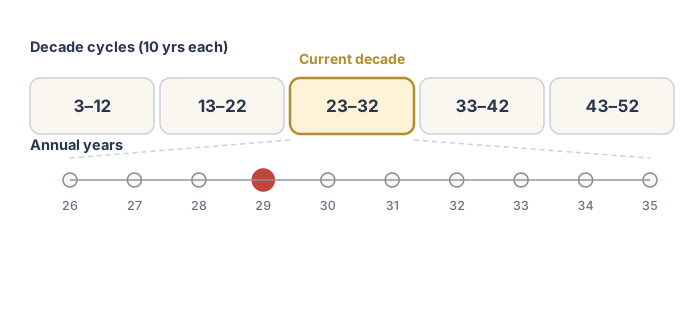
For example, suppose someone’s pillars begin at age three. Their luck pillars then run 3–12, 13–22, 23–32, 33–42, 43–52, and so on — one step per decade. If they are 28 now, they are inside the 23–32 pillar, and within that decade each individual year carries its own annual pillar. The diagram below shows how the two layers fit together:
Annual pillars: the year-by-year shift
The annual pillar is each year’s stem and branch (say, a Bing-Wu year), and it is shared by everyone — in any given year, the whole world meets the same annual pillar. But the same year lands differently on different charts, because what matters is its relationship to each person’s Day Master — the stem in the four pillars that represents you — and their overall elemental structure.
When you read an annual pillar, three layers are actually in play: the natal four pillars are the unchanging base, the current luck pillar is the decade’s backdrop, and this year’s pillar is the variable of the moment. The same annual pillar can act differently against different luck-pillar backdrops — like the same rainfall meaning one thing in the dry season and another in the wet. So judging a year from the annual pillar alone is never enough; at minimum, read it together with the current luck pillar.
Why the year turns at the Beginning of Spring
In Bazi and the Four Pillars system, the year turns at the Beginning of Spring (Lichun) — not on January 1, and not at Lunar New Year either. Lichun is the first of the twenty-four solar terms and usually falls between February 3 and 5.
Here is a concrete case: someone born on February 1 arrives before Lichun, so in Bazi terms their year pillar still belongs to the previous year. Annual pillars work the same way — before each year’s Lichun, the annual pillar is still the old year’s; only after Lichun does the new one take over. People born in January or early February therefore often find their year pillar differs from what they’d assume. This is a rule of the traditional calendar, and any honest account of annual luck should make it clear.
How to use it: three steps to read the time layer
Once you have your chart, read the time layer in this order:
- Find your current luck pillar. Look at the luck pillar list in your chart, match it against your age, and note the stem and branch of the step you’re in.
- Read that pillar against your chart. Do its elements support your Day Master or drain it? Does it supply something your chart lacks, or pile on more of what you already have plenty of? That sets the tone of the decade.
- Layer this year’s annual pillar on top. How does this year’s stem and branch interact with your chart and current luck pillar — pushing in the same direction, or clashing against it? That sets the rhythm of the year.
The order matters: fix the ten-year backdrop first, then read the yearly change, so a single year’s surface impression doesn’t lead you around.
Common misconceptions
- “A bad luck pillar means ten miserable years”? No. A luck pillar describes a phase’s theme and where resources sit. A so-called difficult pillar is often simply a stretch where pressure concentrates and consolidation pays off — not a decade in which nothing goes right.
- “The year you change pillars brings upheaval”? Not necessarily. Crossing into a new pillar is a gradual transition; some people feel it clearly, others pass through smoothly. There is no rule that a pillar change must be turbulent.
- “An annual pillar’s fortune is absolute”? No. The same annual pillar acts completely differently on different charts and against different luck-pillar backdrops. Talking about a year’s luck detached from the chart means little.
- “The time layer predicts specific events”? It doesn’t. Luck pillars and annual pillars describe rhythm and tendency — they help you see what a stretch of time is suited to advancing and what to watch for — not a guarantee that a given thing happens in a given year. They’re a reference for planning, not a fixed script.
Start from your own chart
No amount of theory beats seeing it on your own chart. Casting the chart itself is a deterministic calendar calculation — the starting age of your luck pillars and the stems and branches of every pillar and year are computed, with no subjective judgment involved.
To see your own four pillars and Day Master, start free with the Bazi chart tool.