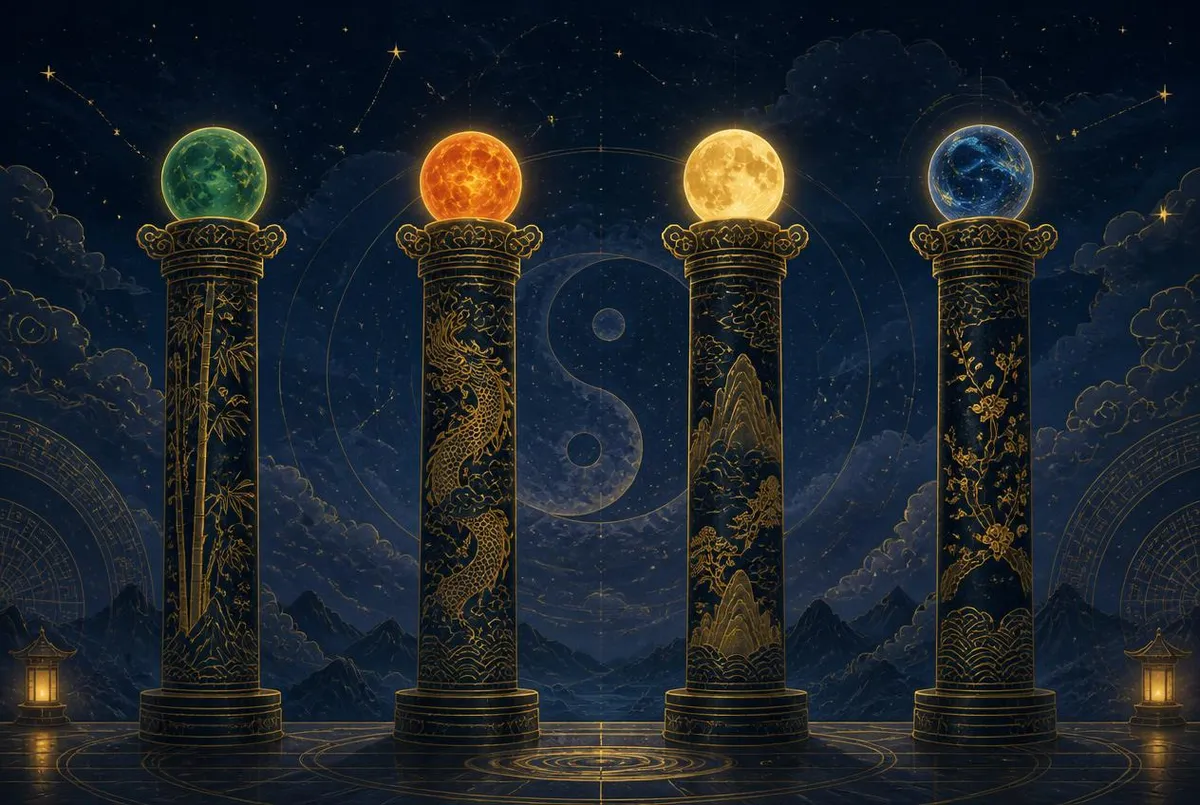
Bazi, also called the Four Pillars of Destiny, converts a person’s birth time — year, month, day, and hour — into four pairs of heavenly stems and earthly branches: four pillars, eight characters in all, which is what “Bazi” (eight characters) means. It is a long-standing system in Chinese culture and, together with Zi Wei Dou Shu, one of the two great traditional methods for reading a life.
Stems and branches sound mystical, but they are simply an ancient timekeeping code: ten heavenly stems paired with twelve earthly branches, cycling to label years, months, days, and hours — an alternative calendar, in effect. Casting a chart just means translating your birth time into that code.
This guide is for someone meeting Bazi for the first time. By the end, you’ll know what each pillar stands for, what the Day Master and the Five Elements are, how to read your own chart in three steps, and which common misconceptions to skip.
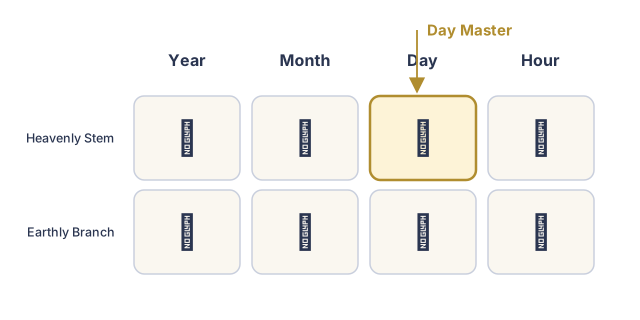
The four pillars
- Year pillar — the stem-and-branch of your birth year; often read for family background and early life. Your Chinese zodiac animal is simply the branch of this pillar.
- Month pillar — set by your birth month; the key to structure and to whether each element runs strong or weak, because your birth season decides how much natural support each element gets. Months are divided by solar terms, not by the lunar calendar.
- Day pillar — the heavenly stem of the day is called the Day Master, and it represents you. It is the center of the chart; the other seven characters are all read in relation to it.
- Hour pillar — set by your birth hour (traditionally a two-hour block); read for later life and children, and it makes the chart complete.
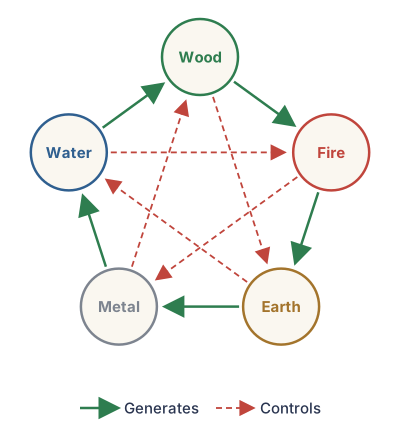
Each of the eight characters carries one of the Five Elements — wood, fire, earth, metal, water — an ancient five-way classification of everything in the world. The elements generate one another (wood feeds fire, fire creates earth…) and control one another (wood breaks earth, earth dams water…), and this interplay is the dynamic foundation of the whole chart.
On top of the pillars and elements, traditional readings also label the Ten Gods: ten role names (such as Direct Officer or Direct Wealth) that classify how each of the other seven characters relates to your Day Master, mapping to areas like career, wealth, and self-expression — “relationship tags” the other characters wear with respect to you. As a beginner, knowing the Day Master and the Five Elements is plenty.
How a Bazi chart is cast
Casting a Bazi chart is a deterministic calculation: given an accurate birth date, time, and place, the four pillars and the distribution of the five elements can be computed exactly — anyone using the same conventions gets the same result. FateNava casts charts with a tested engine; the AI only interprets and explains, it never invents a pillar or an element.
Your birth hour is corrected to True Solar Time using the longitude of your birthplace — the same clock time corresponds to different sun positions at different longitudes, and the hour pillar is only accurate after this correction. When the hour is unknown, the year, month, and day pillars can still be cast; only the hour pillar and part of the reading are left out — we don’t fabricate a time for you.
How to read your own chart, step by step
Let’s walk the example chart from the diagram above — Geng-Chen year, Wu-Zi month, Jia-Yin day, Bing-Yin hour — through the three most basic steps.
Step 1: Find your Day Master
Look at the heavenly stem of the day pillar. In the example, the day pillar is Jia-Yin, so the stem is Jia, which belongs to wood — this chart’s Day Master is Jia wood. The Day Master is “you in the chart”; everything else is read around it.
Step 2: Count the Five Elements
Tally the element of each of the eight characters: Geng is metal, Chen is earth, Wu is earth, Zi is water, Jia is wood, Yin is wood, Bing is fire, and the second Yin is wood again. The totals: wood 3, earth 2, metal 1, water 1, fire 1 — wood clearly dominates, while the other four run thin. This step is just honest counting; no conclusions yet.
Step 3: Judge strength and balance
Ask one simple question: is the Day Master’s element well-supported in this chart? Here, Jia wood sits directly on a Yin branch (wood on its own ground), the hour branch is another Yin, and the Zi water in the month feeds wood — so this Jia wood is on the strong side. Strong or weak is not good or bad in itself; it points to which elements would bring the chart into better balance, and that is where all further interpretation starts.
Common misconceptions
Is Bazi a fixed destiny?
No. Bazi describes tendencies and rhythm — more like a weather forecast than a verdict. The same chart, placed in different environments and choices, walks different roads.
What if I don’t know my birth hour?
You can still cast the year, month, and day pillars — the Day Master and most of the elemental picture remain; only the hour pillar and readings that depend on it are left out. Don’t guess an hour: a wrong guess distorts more than a blank.
Why do different websites give different charts?
Three usual causes: whether True Solar Time correction is applied, whether months are divided by solar terms or by the lunar calendar, and which day the late-night Zi hour belongs to. Different conventions can shift a whole pillar; pick a tool whose conventions are consistent and openly stated.
Do people with the same Bazi live the same life?
No. Many people are born in the same two-hour window. Bazi provides the same “draft of tendencies” — family, place, era, and personal choices write that draft into very different stories.
What Bazi can and can’t tell you
Bazi describes tendencies, rhythm, and themes — whether the five elements are balanced, whether the Day Master is strong or weak, and the themes of different life stages — not a fixed fate. Treat it as a mirror for understanding yourself, not a prediction of guaranteed outcomes.
Concretely, Bazi is good for reading tendencies in character and style (which elements stand out, which run short), the rhythm of life stages (the themes sketched by Luck Pillars and Annual Pillars), and themes worth attention (the lessons tied to an element in excess or shortage) — all tendency-level information that helps you choose with more direction.
Conversely, some questions should not be put to a chart: it cannot declare that an event “will certainly happen” or “can never happen,” it is no substitute for medical advice, and it is not a basis for investment decisions. Any reading that presents a chart as an ironclad verdict deserves skepticism.
To see your own four pillars and Day Master, start free with the Bazi chart tool — no sign-in required.