A natal chart (also called a birth chart) is a snapshot of the sky at the exact moment and place you were born. It maps where the Sun, the Moon, the planets, and key points such as the Ascendant stood, as seen from your birthplace, and arranges them on a wheel divided into twelve sections. It is the foundation of Western astrology — every reading, from a personality profile to a year-ahead forecast, starts from this one map.
If you have ever looked up your zodiac sign and felt the description was only half right, the natal chart is the missing context. Your familiar “star sign” is just your Sun sign — one placement out of a dozen or more. The full chart adds your Moon, your rising sign, and every planet, each colouring a different part of life.
This guide is written for complete beginners. By the end, you will know what the pieces of a chart are, how the wheel is organised, a simple three-step way to read your own chart, and — just as important — what a natal chart can and cannot tell you.
What a natal chart is made of
Every natal chart, no matter how complicated it looks, is built from four kinds of pieces. A useful shorthand: planets are the actors, signs are the costumes, houses are the stages, and aspects are the dialogue.
- Planets — what energy. Each planet stands for a basic drive: the Sun is identity and vitality, the Moon is emotion and instinct, Mercury is thinking and communication, Venus is love and values, Mars is action and desire, and so on.
- Signs — in what style. The twelve zodiac signs describe how a planet expresses itself. Mars in Aries acts fast and directly; Mars in Libra weighs options first. Same drive, different style.
- Houses — in which area of life. The twelve houses divide the chart into life arenas: self, money, communication, home, creativity, work, relationships, and more. A planet’s house shows where its energy tends to play out.
- Aspects — how the energies talk to each other. Aspects are the geometric angles between planets. Some angles flow easily (trines, sextiles), while others create friction that pushes growth (squares, oppositions). Think of them as the conversations between your different drives.
You can read any natal placement as a sentence: planet (what) + sign (how) + house (where). “Venus in Gemini in the 10th house” becomes: love and charm (Venus), expressed through words and curiosity (Gemini), most visible in career and public life (10th house).
How to read the structure of the wheel
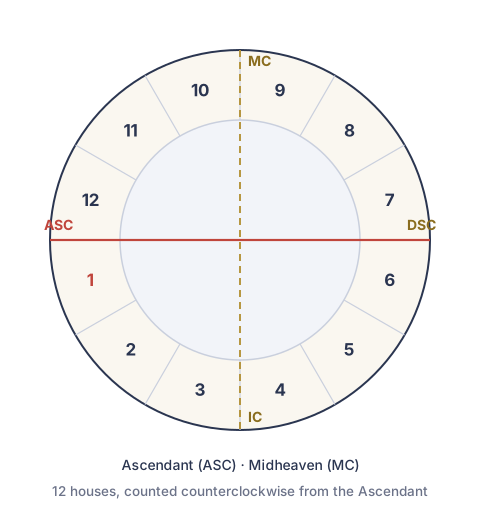
The wheel is oriented by four angles, which come directly from your birth time and place:
- Ascendant (ASC) — the sign rising on the eastern horizon at your birth, drawn at the left edge of the wheel. It sets your rising sign and marks the start of the 1st house: your outward manner and first impressions.
- Descendant (DSC) — directly opposite the Ascendant, at the right edge. It opens the 7th house of partnerships.
- Midheaven (MC) — near the top of the wheel, opening the 10th house: career, reputation, and public direction.
- IC (Imum Coeli) — at the bottom, opposite the MC, opening the 4th house: home, family, and roots.
Starting from the Ascendant, the twelve houses are numbered counterclockwise — 1st, 2nd, 3rd, and onward — one for each life area. So when you look at a chart, start at the left edge and travel counterclockwise around the wheel.
The lines criss-crossing the middle of the wheel are the aspects. You may also meet names like grand trine, T-square, or stellium — these are simply recurring shapes that several aspects or planets form together. Beginners don’t need to memorise them; just know they are patterns built from the basic pieces above.
A three-step reading for beginners
You don’t need to interpret everything at once. This order covers the most ground with the least effort:
- Start with the Big Three — Sun, Moon, and Ascendant. The Sun is your core identity, the Moon your emotional life, the Ascendant your outward style. Together they sketch a surprisingly recognisable portrait.
- Look for where planets cluster. A house holding several planets is a busy arena — that area of life (career, relationships, home…) tends to demand, and reward, more of your attention.
- Check the major aspects. Note the strongest angles, especially anything touching your Sun or Moon. Flowing aspects point to natural talents; tense ones point to where growth tends to happen.
Common questions
Is my daily horoscope the same as my natal chart? No. Horoscope columns are written for the twelve Sun signs only — one-twelfth of the picture. A natal chart is calculated from your exact birth data and is unique to you.
What if I don’t know my exact birth time? Be honest about the limits: the Ascendant and the houses depend on an accurate birth time, so without it those parts are unreliable. Your Sun sign, most planetary signs, and many aspects still hold (the Moon can occasionally change signs within a day). Note that FateNava also corrects your clock time to True Solar Time based on the longitude of your birthplace, so the houses are computed from the sky as it actually stood.
Does my natal chart change over time? No. It is a fixed snapshot of one moment. What changes is the current sky — astrologers compare today’s planets (“transits”) against your unchanging natal chart. You grow and change; the map stays the same, and you keep reading new things in it.
Is casting a chart guesswork? The chart itself is not. Given your birth date, time, and place, the positions are computed deterministically from astronomical ephemeris data — any correct calculator produces the same chart. Interpretation is where perspectives differ: at FateNava, the engine computes the positions and the AI only interprets and explains them — it never invents them.
What it can and can’t tell you
A natal chart describes tendencies, themes, and timing — the recurring patterns and questions of a life. As a language for self-reflection it is genuinely useful: once a pattern has a name, it becomes easier to work with.
It is not a script. It cannot fix your decisions in advance, guarantee outcomes, or replace professional advice on health, finances, or anything else with real stakes. Two people with similar charts can live very different lives: the chart shows the terrain, and you choose the route.
See your own chart
Reading about charts only goes so far — it clicks the moment you see your own. FateNava calculates your natal chart for free, with no sign-up required: enter your birth date, time, and place, and explore your Big Three, houses, and aspects with plain-language AI explanations.