If you already know your star sign, your first serious look at Bazi usually starts with one question: how are these two systems different? And if you grew up with Bazi, astrology apps raise the mirror-image question: are the Sun, Moon, and rising sign describing the same “me”? People who have touched both tend to get stuck at the same point — which one is right, and which one should I follow?
The two systems actually share a starting point: both take the moment you were born and turn it into a chart you can read and re-read. The difference is the language. Bazi — the Four Pillars of Destiny — speaks the calendrical language of heavenly stems, earthly branches, and the Five Elements; Western astrology speaks the spatial language of planets, signs, and houses.
This article walks through what each system actually looks at, lines up three pairs of concepts that are easy to confuse, and then answers the old question: which one should you choose?
What Bazi looks at: the Day Master, the Five Elements, and a timeline
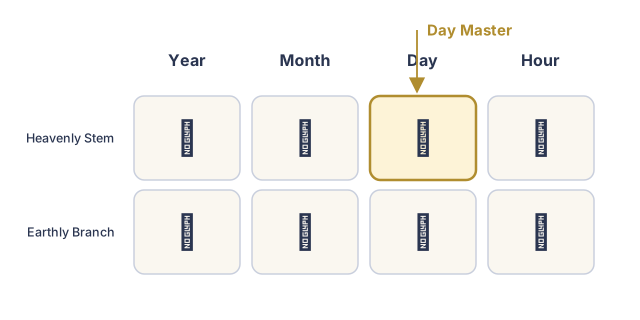
Bazi converts your birth year, month, day, and hour into four pairs of stems and branches — eight characters in total, which is what “Bazi” means. This step is pure calendar computation: the same birth data always produces the same chart.
At the center sits the Day Master — the heavenly stem of the day pillar, which stands for you. Everything else in the chart is read in relation to it: whether the other seven characters support, drain, or clash with the Day Master shapes the chart’s Five Elements structure. Which of Wood, Fire, Earth, Metal, and Water runs strong, which runs weak, and where they cluster — that is the raw material Bazi uses to describe temperament and life themes.
Bazi also comes with an explicit timeline: Luck Pillars shift roughly every ten years, and the Annual Pillar changes each year. Layered over the birth chart, they describe the “weather” of different life stages — Bazi is, at heart, a language of when.
One detail worth knowing: the hour pillar is traditionally defined by the Sun’s actual position at your birthplace, so a careful chart applies a True Solar Time correction, adjusting clock time by longitude so the hour pillar doesn’t come out wrong.
What Western astrology looks at: Sun, Moon, rising, and the whole chart
A birth chart (natal chart) records where the Sun, Moon, and planets sat along the twelve zodiac signs at the moment you were born. The sign people quote in conversation is only the Sun sign — one element among a dozen or more in the full chart.
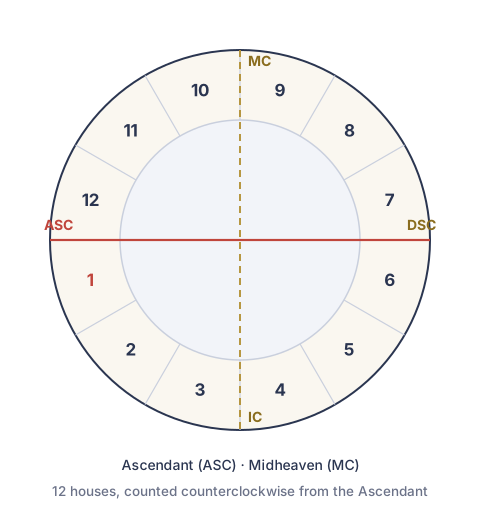
Most introductions start with the “big three”: the Sun for core identity and life direction, the Moon for emotional needs, and the rising sign (ASC) for how you meet the world and the first impression you give. From there, each planet’s sign (the style it operates in), its house (the life area where it plays out), and the aspects between planets (cooperation or tension) build up a layered map of personality and inner dynamics.
Astrology has timing tools of its own — transits (where the planets are right now, relative to your chart) and progressions — used to read the themes of different periods.
The same question in two languages
The two systems often answer similar questions from different frames of reference. Three common pairings:
- Day Master ↔ Sun + rising. Both answer “who am I?” Bazi anchors the self in a single character — the Day Master — and reads the whole chart around it. Astrology splits the self apart: the Sun as the core, the rising sign as the interface with the world; only together do they come close to the role the Day Master plays.
- Luck Pillars and Annual Pillars ↔ transits and progressions. Both answer “what time is it in my life?” Bazi advances by the stem-branch calendar in ten-year and one-year steps; transits track the real planets moving against your birth chart. Different mechanics, same ambition: describing the climate of a life stage.
- Five Elements balance ↔ element distribution. Both answer “how is my energy distributed?” Bazi weighs the strength and clustering of Wood, Fire, Earth, Metal, and Water; astrology counts planets across the fire, earth, air, and water signs.
The key caveat: these pairings mean the questions are similar, not that the vocabularies translate. Fire in the Five Elements is not fire in the zodiac, and a Day Master cannot be converted into a star sign. They are independent frames of reference, each internally consistent.
Common misconceptions
- “My Day Master is Fire — does that make me a fire sign?” No. The Five Elements and the four classical elements are separate classifications built on different calendrical and astronomical foundations. The two labels often disagree for the same person — and that’s normal.
- “If the two charts say different things, is one of them wrong?” Not necessarily. The systems sample different information at different levels of detail. Diverging conclusions are more like two advisors offering different angles — inputs to weigh side by side, not a verdict to pick.
- “So which one is more accurate?” There is no shared yardstick for “accurate” here, because the systems measure different things. A better question is which language fits what you actually want to ask right now.
- “Isn’t knowing my Sun sign or Day Master enough?” It isn’t, on either side. The Sun sign is one corner of a birth chart; the Day Master only means something inside the full Five Elements structure and its Luck Pillars. Grabbing a single label and drawing conclusions is the shared cardinal sin.
How to choose — you may not have to
If you want to read life rhythm and timing through the Five Elements, chart structure, and Luck Pillars, Bazi feels natural. If you want to read personality and relationship dynamics through planets, houses, and aspects, astrology is intuitive. Neither is superior; they differ in language and in what they do best.
The practical move: cast both and compare. A trait that shows up in both charts usually deserves attention; one that appears on only one side works as a complementary angle. Casting is deterministic computation, and free tools give you both charts in minutes — the cost of comparing is low.
To cast a Bazi chart and a natal chart side by side, start free with the chart tool. Charts are computed by a deterministic engine; the AI only interprets.