
When you want to understand your tendencies in love and marriage, the place Zi Wei Dou Shu looks at first is the Marriage Palace (also called the Spouse Palace). If you have ever wondered what you are like inside a relationship — how you give, what you expect, where you tend to get stuck with a partner — this is the corner of the birth chart that speaks to it most directly.
Many people hear “Marriage Palace” and assume it predicts who they will marry and when. It doesn’t work that way. The Marriage Palace is closer to a mirror: it reflects your own pattern in intimate relationships — what draws you in, how you attach, and which frictions tend to repeat.
This guide walks you through it in plain language: where the Marriage Palace sits, what it governs, how to read it step by step, and the common misreadings worth avoiding.
Where the Marriage Palace is, and what it governs
Zi Wei Dou Shu divides a birth chart into twelve palaces, each covering one area of life: the Life Palace for your overall makeup, the Wealth Palace for money, the Career Palace for work — and the Marriage Palace for marriage and intimate relationships.
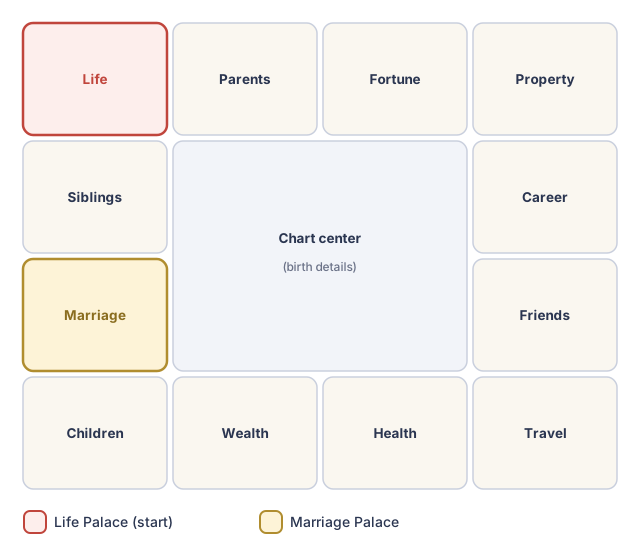
The Marriage Palace lands in a different position for each person. Charting starts from your birth date and — crucially — your birth hour, which fixes the Life Palace; the other palaces, including the Marriage Palace, then follow in a set order. This is why casting a Zi Wei chart always requires the birth hour: a different hour rearranges the whole board.
One thing worth holding onto: the Marriage Palace describes your pattern and your lessons in close relationships — it is not a verdict on “what your spouse will look like.” It speaks to whether you lean toward leading or accommodating, toward feeling or practicality, what kind of character tends to attract you, and where this bond most needs care.
How to read the Marriage Palace
There are three layers, from simple to subtle.
1. The temperament of the major stars
The major stars sitting in the Marriage Palace set the tone of your relational style. A few examples to get the flavor:
- Tai Yang (the Sun) — bright, direct, warm; little is left unsaid, and openness is expected in return.
- Tian Tong — gentle, easygoing, companionship-first; comfort and security in the relationship matter a great deal.
- Qi Sha (Seven Killings) — independent, strong-willed, decisive; needs room to breathe, and respects a capable partner.
One caution: major stars often sit two to a palace, and their temperaments blend. The same star reads quite differently next to different companions — which is why you read the combination, never a single keyword.
2. Supporting stars and challenging stars
Auspicious stars in the palace (such as Zuo Fu, You Bi, Tian Kui, Tian Yue) generally suggest support and helpful people along the way. Challenging stars (such as Qing Yang, Tuo Luo, Huo Xing, Ling Xing) flag friction points worth attention — impatience, push-and-pull, or long stretches apart. A challenging star is a reminder, not a sentence.
3. The palace across from it
Directly opposite the Marriage Palace sits the Career Palace. The pairing is telling: it hints that love and work pull on each other. The rhythm and strain of your working life reflect into the quality of your closest relationship — and the steadiness of that relationship, in turn, shapes how you perform at work. Reading the Marriage Palace together with its opposite gives you the full picture.
A three-step self-check you can do now
- Find the major star in your Marriage Palace. Cast your chart with a charting tool — the calculation is deterministic, free, and requires no sign-up — then locate the Marriage Palace among the twelve and note which star (or pair of stars) sits there.
- Translate the star into plain language. Set the jargon aside and ask, “what kind of person does this star feel like?” — fiery and direct, or gentle and slow to warm? That is the base color of how you love.
- Layer in the decade and annual cycles. The same Marriage Palace gets activated differently across each decade luck cycle and annual cycle — the natal chart is the base color; the cycles are the current weather.
Common misreadings
- A challenging star in the Marriage Palace means an unhappy marriage? No. It marks the lesson of the relationship — learning to pace, learning to speak up. Many lasting couples turned exactly that lesson into their strongest habit.
- What if the Marriage Palace is empty? An empty palace does not mean “no love” or “destined to be single.” You borrow the stars of the opposite palace (the Career Palace) for reference; it often signals a more flexible relational style, more responsive to the season of life you are in.
- Can it tell me the age I’ll marry? Honestly: no, not with precision. The cycles can suggest which periods bring relationship themes to the foreground, but “you will marry in year X” is not an answer Zi Wei Dou Shu can give — or should.
- A “bad” Marriage Palace means don’t marry? No chart concludes “you cannot marry.” Every configuration has a way of working well; the point is knowing your pattern and choosing to work at it.
What it can show — and what it can’t
It can show: your tendencies and needs in close relationships, the kind of character you’re drawn to, the frictions that tend to recur, and which life phases bring relationship themes forward.
It can’t show: a precise portrait of your future spouse, the exact year of a wedding, or a verdict that a marriage is “destined to succeed or fail.” Treat the Marriage Palace as a map for understanding yourself, not a sentence handed down — a real relationship is always built by two people.
To see how two people’s charts interact, start with the compatibility tool — you can switch between Bazi, Zi Wei, and astrology inside the tool.