
Zi Wei Dou Shu (Purple Star Astrology) is, alongside the Four Pillars of Destiny (Bazi), one of the two great destiny systems of Chinese culture. From your birth year, month, day, and hour it casts a birth chart that turns the sky into twelve palaces (the 12 palaces) — a “map of a life” where love, career, money, and health each have their own address. Where Bazi reads the overall pattern through the Five Elements, Zi Wei excels at zooming into one area at a time: if you want to know your tendencies in a specific part of life, Zi Wei is often the more direct lens.
This guide is for you if you’re new to Chinese metaphysics, if you know Bazi and want a second angle, or if you’ve been handed a chart and have no idea where to look first. By the end you’ll know what each of the twelve palaces governs, what the major stars are, and a three-step method for reading your own chart.
One thing to be clear about up front: casting the chart is a deterministic calculation. Given an accurate birth time and place, the twelve palaces and the star placements come out exactly the same no matter who computes them — the skill lies in the reading. FateNava casts the chart with an engine (including automatic True Solar Time correction), and the AI only interprets. The chart tool is free and requires no sign-up.
The twelve palaces: twelve rooms of a life
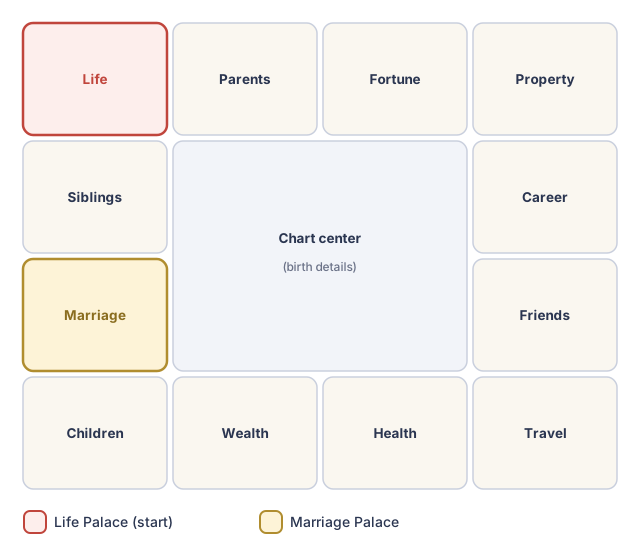
Picture the chart as a house with twelve rooms: an outer ring of twelve palaces surrounding a central panel with your birth data. The Life Palace is the starting point of the whole chart — it stands for you — and the other eleven palaces unfold from it in sequence:
- Life Palace — your core temperament and the overall tone of your life.
- Siblings Palace — bonds with siblings and peers.
- Marriage Palace — marriage and intimate relationships.
- Children Palace — your rapport with children and juniors, and your creativity.
- Wealth Palace — finances and how you earn.
- Health Palace — constitution and health themes.
- Travel Palace — journeys, relocation, and how the outside world receives you.
- Friends Palace — support from friends, colleagues, and subordinates.
- Career Palace — the shape and scale of your working life.
- Property Palace — real estate, home environment, and family fortunes.
- Well-being Palace — inner life, interests, and contentment.
- Parents Palace — your relationship with parents and elders.
Together, the twelve palaces form a complete cross-section of a life: whichever area you’re curious about, that’s the room you walk into.
The major stars: the characters in each room
If the palaces are rooms, the major stars are the characters living in them. Zi Wei Dou Shu has fourteen major stars, each with its own personality. Three examples:
- Zi Wei (the Emperor star) — dignified and commanding. Whichever palace it lands in, that area of life carries a “wants the lead role” quality.
- Tan Lang (the Desire star) — appetite and versatility: strong curiosity, many talents, and a hearty hunger for life.
- Tian Tong (the Contentment star) — gentle and easygoing, valuing comfort, lending a peaceful undertone.
The key point: no star is absolutely good or bad. The same star behaves very differently in different palaces and combinations — Tan Lang in the Career Palace can show up as multi-track talent, while in the Marriage Palace it points to a need for novelty in love. A reading always weighs star + palace + combination, never a verdict from a single star. On top of this, the Four Transformations (Hua Lu, Hua Quan, Hua Ke, Hua Ji) amplify certain stars or introduce variables — an important dynamic in more advanced readings.
Read your own chart in three steps
Holding a chart and not sure where to start? Follow these three steps:
- Find the major star in your Life Palace. The Life Palace is the baseline of “you” — the star sitting there is the main theme of your temperament.
- Look at the palace you care about. Curious about work? Check the Career Palace. About love? The Marriage Palace. Read the major star and combination sitting there.
- Check the opposite palace. Every palace has a counterpart directly across the chart that mirrors it — the Life Palace faces the Travel Palace, the Marriage Palace faces the Career Palace. The stars opposite fill in the other half of the picture.
Common misconceptions
- “Does an empty Life Palace mean a bad chart?” No. When the Life Palace has no major star, you borrow the stars from the opposite palace — it’s simply a different chart type, not a worse fate.
- “Will Zi Wei and Bazi contradict each other?” The two systems use different frames: Zi Wei examines life palace by palace, while Bazi reads elemental balance and the rhythm of time. Different angles, different strengths — most of the time they complement rather than conflict.
- “Do difficult stars in the Marriage Palace mean my marriage is doomed?” A chart describes tendencies and themes, not sentences. The Marriage Palace points to patterns a relationship may fall into — and knowing them is exactly what lets you work with them.
- “Can I still use Zi Wei if I don’t know my exact birth hour?” Zi Wei does need the birth hour to fix the Life Palace. If you only remember a rough window (say, “morning” or “around dusk”), you can cast a provisional chart from that window — just know the Life Palace may shift, so it’s worth confirming the hour with family or a birth record before reading closely.
What it can tell you — and what it can’t
Zi Wei Dou Shu can tell you: the baseline of your temperament, the tendencies and themes in each area of life, and the rhythm of different life stages. It cannot tell you that a specific event will happen, or that a relationship is destined to succeed or fail. The chart is a map — it marks the terrain and road conditions; how you travel is still up to you.
To see your own twelve palaces and the major star in your Life Palace, start free with the Zi Wei chart tool.